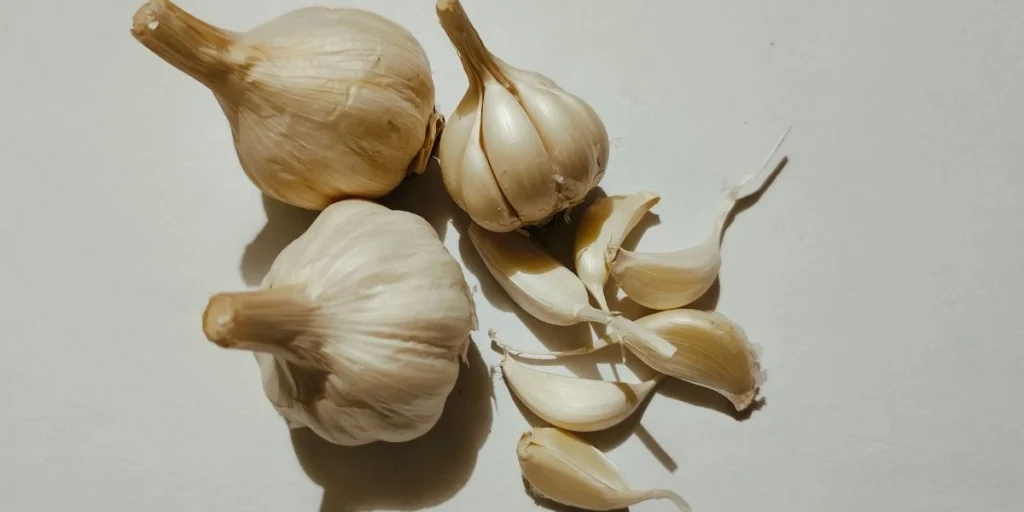
What is raw and what is aged (black) garlic?
- Raw garlic (Allium sativum) contains allicin , a powerful sulfur compound that is released when crushed. Allicin has antibacterial and anti-inflammatory properties, but it is very unstable . (1*)
- Aged garlic (often called black garlic ) is produced by slowly fermenting or heat-treating garlic under high humidity conditions. During this process, allicin is broken down into stable compounds , particularly S-allyl cysteine (SAC) – a key component with documented health benefits. (1,2)
6 Key Benefits of Aged Garlic
1. More stable and stronger antioxidants
Fermentation increases the content of S-allyl cysteine (SAC) from a few hundred to up to 8,000 µg/g , which means higher antioxidant and anti-inflammatory protection compared to raw garlic. (1)
2. More digestible
Aged garlic has a delicate flavor, without a strong odor , and does not irritate the stomach – therefore it is suitable for people with sensitive digestive systems or for regular consumption.
3. To protect the heart and blood vessels
Regular consumption of aged garlic may reduce the oxidation of LDL cholesterol , which reduces the risk of atherosclerosis and heart disease . (3*)
4. Support for diabetes and high blood pressure
Review studies show that SAC from aged garlic helps lower blood pressure, blood sugar , and inflammatory markers – without the side effects of raw garlic. (4*)
5. Neuro- shield
SAC has a potential protective role in Alzheimer’s and Parkinson’s disease – it reduces oxidative stress and inflammatory processes in the brain. (5*)
6. Inhibits glycation – the aging process
Aged garlic is more effective than raw garlic in inhibiting glycation , a harmful process that damages proteins and is linked to aging and chronic diseases . (6*)
Comparison chart: Raw vs. aged garlic
| Property | Raw garlic | Aged (black) garlic |
| Primary compound | Allicin (unstable) | S-allyl cysteine (stable) |
| Antioxidant power | Effective but short-lived | High, long-lasting |
| Digestibility | May irritate stomach, strong odor | Stomach-friendly, mild scent |
| Effects on the heart and blood | Possible, but limited | Proven protective effects |
| Neuro-protection | Minimal | Prominent in research |
| Anti-glycation | Modest effects | Strong protection |
Which garlic is better?
- Raw garlic has its benefits – especially allicin , which works quickly and effectively, but is less stable and often irritates the stomach .
- Aged garlic offers gentler, longer-lasting protection . It contains more stable compounds , has a milder flavor , is easier to digest , and has been shown to support heart, nervous system, and metabolic health .
Literature: (*)
1. Source: S-Allyl cysteine in garlic (Allium sativum): Formation, biofunction, and resistance to food processing for value-added product development, (B. Yudhistira, F. Punthi, JA Lin, AS Sulaimana, CK Chang, CW Hsieh), https://pubmed.ncbi.nlm.nih.gov/35355410/
2. Source: Effect of Thermal Processes on S-Allyl Cysteine Content in Black Garlic, (K. Manoophol, U. Suttisansanee, C. Promkum, C. Butryee), https://pmc.ncbi.nlm.nih.gov/articles/PMC10048598/
3. Source: The antioxidant mechanisms underlying the aged garlic extract- and S-allylcysteine-induced protection, (AL Colín-González, RA Santana, CA Silva-Islas, ME Chánez-Cárdenas, A. Santamaría, PD Maldonado), https://pubmed.ncbi.nlm.nih.gov/22685624/
4. Source: Daily supplementation with aged garlic extract, but not raw garlic, protects low density lipoprotein against in vitro oxidation, (JS Munday, KA James, LM Fray, SW Kirkwood, KG Thompson), https://pubmed.ncbi.nlm.nih.gov/10217370/
5. Source: Ameliorating effect of S-Allyl cysteine (Black Garlic) on 6-OHDA mediated neurotoxicity in SH-SY5Y cell line, Y. Yeni, B. Cicek, S. Yildirim, İ. Bolat, A. Hacimuftuoglu), https://pmc.ncbi.nlm.nih.gov/articles/PMC11525226/
6. Source: Aged garlic has more potent antiglycation and antioxidant properties compared to fresh garlic extract in vitro, (A. Elosta, M. Slevin, K. Rahman, N. Ahmed), https://pubmed.ncbi.nlm.nih.gov/28051097
Read our latest posts
- Nettle – a natural gift of forest wisdom
 Stinging nettle (Urtica dioica) is an ancient medicinal plant rich in nutrients and antioxidants. It is clinically supported for its allergy relief, anti-inflammatory and nutritional value. Nettle tea or dishes provide gentle yet effective support for the body.
 - Burns: how to recognize them, take action and restore the skin with Ribogal fish ointment
 Burns weaken the skin barrier, causing moisture loss and inflammation. Quick first aid includes cooling and the use of gentle ointments. Ribogal fish ointment, rich in petrolatum, lanolin and omega-3 fatty acids, supports skin regeneration, guides its protection and hydration, and accelerates the healing process.
 - Yogurt bowl with flaxseed for energy, digestion and heart
 Yogurt bowl with flaxseed, berries and nuts – a nutritious and refreshing meal, rich in fiber and omega-3 to support the heart and digestion.